

The Governing Mandate
Environmental Obligation accounting rests on a core assumption: reported liability balances reflect the estimated cost of obligations that remain outstanding. An Environmental Obligation exists because required retirement or remediation activities have not yet been completed. The obligation is reduced or derecognized only when objective evidence demonstrates that the obligation has been partially or fully satisfied.
Accounting standards explicitly rely on this linkage. ASC 410-20 requires Asset Retirement Obligations to be measured based on the present value of expected cash flows required to settle the obligation. ASC 410-30 requires Environmental Remediation Obligations to reflect the current estimate of costs to complete required activities. Both standards assume that organizations can identify what portions of an obligation remain open, what portions have been settled, and how settlement activity affects the remaining liability balance.
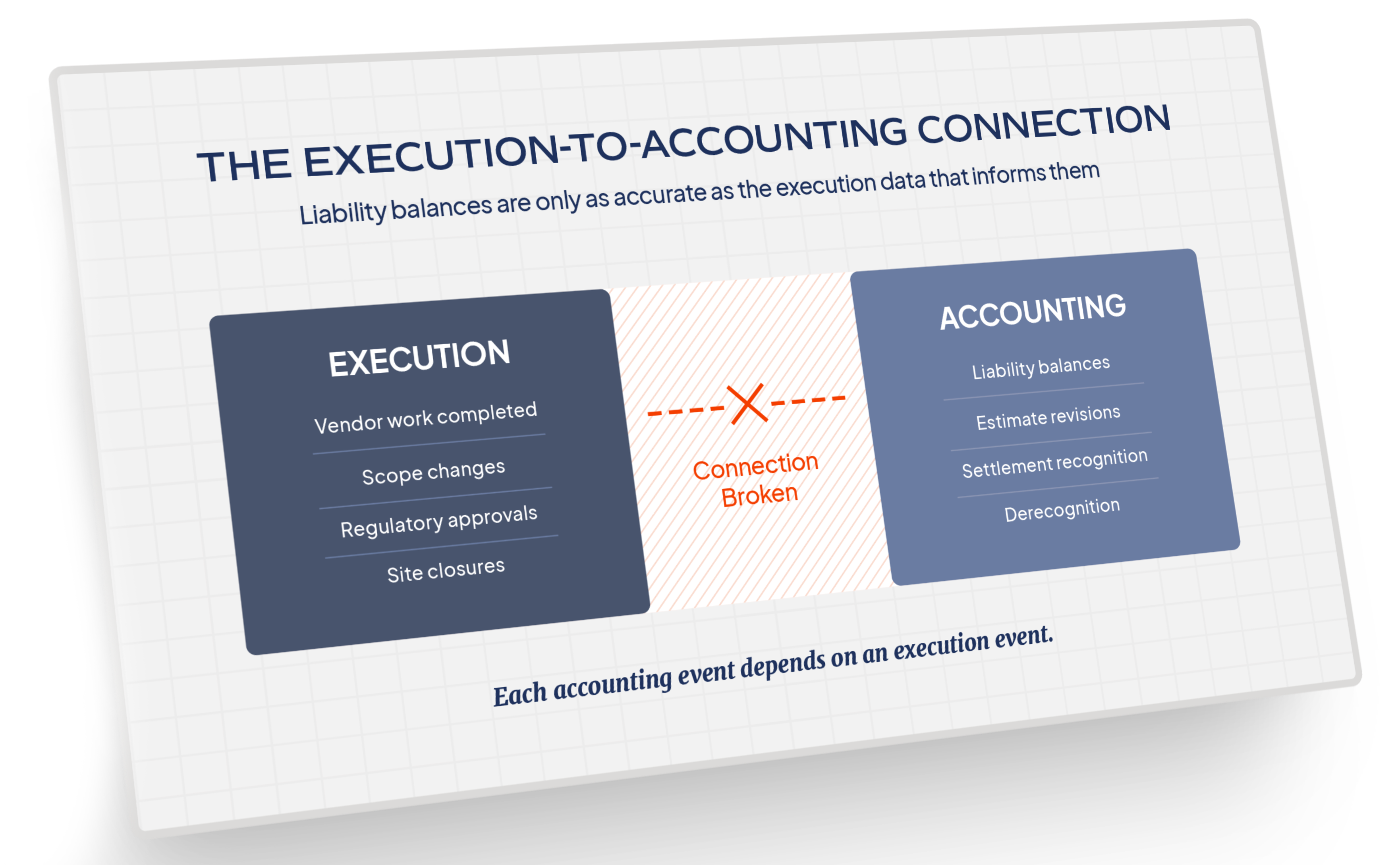
The mandate is therefore one of accounting integrity, not operational optimization. Liability balances are only as accurate as the evidence used to support settlement recognition, derecognition, and estimate revisions. When settlement activity, obligation status, and accounting records are not governed together, reported liabilities diverge from reality.
Accounting follows execution only to the extent that execution evidence is governed, traceable, and reconciled.
The Structural Breakdown
Most organizations lack a governed mechanism to connect obligation-related activity with accounting records in a controlled and auditable way. The breakdown is structural.
Evidence of settlement and obligation status resides outside the accounting system of record. Supporting documentation is generated across vendors, consultants, project files, correspondence, and internal records. Finance receives fragments of this information, typically in the form of summarized expenditures or invoices, without sufficient context to determine how those transactions relate to specific Environmental Obligations or accounting balances.
Settlement recognition is therefore inconsistent. Reductions to liability balances and derecognition decisions require evidence that an obligation, or a defined portion of it, has been satisfied. In practice, organizations do not consistently track settlement evidence against individual Environmental Obligations at the level required for accounting governance. Accounting teams maintain liability control accounts at a summarized level, while obligation-level evidence resides elsewhere.
Estimate revisions inherit this disconnect. Accounting standards require that changes to Environmental Obligation estimates be grounded in documented changes to assumptions, scope, timing, or obligation status. Revision entries must be calculated against a defined baseline balance as of the effective date of the change. When settlement activity and obligation status cannot be reconciled to that baseline, revision accounting becomes difficult to defend.
The result is parallel systems describing the same obligations differently, with no authoritative reconciliation point.
EXPLORE ENFOS TODAY

The Strategic Consequences
When execution evidence and accounting records are not governed together, the consequences extend beyond audit findings.
Indefensible Settlement and Revision Accounting: Completed obligation-related activity does not reduce liabilities accurately or consistently. Revision entries may be directionally reasonable but lack defensible linkage to documented settlement evidence or baseline balances. Environmental Obligation balances may be overstated or understated as a result.
Persistent Reconciliation Failures: Accounting and other functions maintain different views of obligation status and remaining exposure. Reconciliation occurs manually, under time pressure, and produces negotiated outcomes rather than verified results. Discrepancies reappear period after period because the underlying structure remains unchanged.
Weakened Control Environment: Effective controls require that liability reductions and derecognition be supported by verifiable evidence, matched to specific Environmental Obligations, and reflected consistently in accounting records. When evidence and accounting operate in parallel without governance, controls exist in policy but fail in practice.
These failures rarely surface during routine operations. They are exposed during audits, transactions, and regulatory scrutiny, when the cost of correction is highest.
Category Implication
Environmental Obligation accounting cannot be sustained without governed linkage between obligation status and accounting records.
Environmental Obligation Management defines the discipline required to govern settlement evidence, obligation status, and accounting balances within a single, controlled system of record. That structure ensures that liability reductions, derecognition, and estimate revisions are supported by traceable evidence and reconciled to accounting records over time.
Without governed execution evidence, Environmental Obligation accounting degrades. Environmental Obligation Management exists to ensure that Environmental Obligations are reduced, revised, and derecognized only when supported by defensible, auditable evidence, for as long as they remain on the balance sheet.





.webp)